
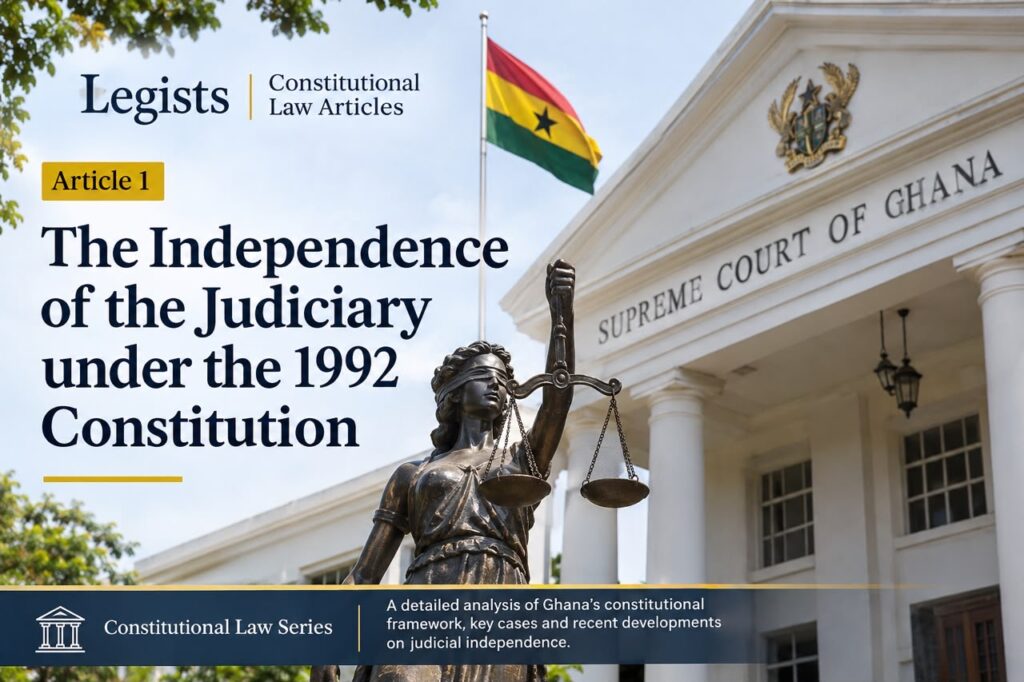
Judicial independence means that judges decide cases according to the law and the evidence, free from pressure by the government, politicians, parties or the public. Ghana’s 1992 Constitution protects it more strongly than any of the country’s earlier constitutions, largely because of the country’s painful history. On 30 June 1982, three High Court judges and a retired army officer were abducted and murdered. Ghana now remembers that day as Martyrs’ Day.
The constitutional framework
Chapter 11 of the 1992 Constitution establishes the judiciary. Its key guarantees are set out below.
Provision What it guarantees
Article 125(1) Justice emanates from the people and is administered in the name of the Republic by the judiciary, which is independent and subject only to the Constitution
Article 125(3) Judicial power is vested in the judiciary; neither the President, Parliament nor any organ of the President or Parliament has final judicial power
Article 127(1) In exercising judicial power, the judiciary and judges are subject only to the Constitution and not to the control or direction of any person or authority
Article 127(2) No one may interfere with judges or judicial officers in the exercise of their judicial functions
Article 127(3) Judges are immune from civil action or suit for anything done in the performance of their judicial functions
Article 127(4)–(6) The judiciary has financial autonomy; its administrative expenses are charged on the Consolidated Fund
Article 127(5) Judges’ salaries, allowances and conditions of service cannot be varied to their disadvantage
Article 144 Rules for appointing the Chief Justice, Supreme Court justices and other superior court judges
Article 145 Retirement ages and conditions of service
Article 146 The only grounds and procedure for removing superior court judges
Appointment of judges
Under article 144(1), the President appoints the Chief Justice, acting in consultation with the Council of State and with the approval of Parliament. Other Supreme Court justices are appointed by the President acting on the advice of the Judicial Council, in consultation with the Council of State and with Parliament’s approval. Justices of the Court of Appeal and the High Court are appointed by the President on the advice of the Judicial Council.
Critics argue that the President’s central role in these appointments, combined with the absence of a fixed number of Supreme Court justices, allows governments to shape the court. The Constitution sets a minimum of the Chief Justice and not less than nine other justices, but no maximum, so a President can increase the court’s size at will.
Security of tenure and removal
Security of tenure is the strongest protection of independence. Under article 145, superior court judges may retire at 60 and must retire at 70 (Supreme Court and Court of Appeal) or 65 (High Court).
Under article 146, a superior court judge can be removed only for:
stated misbehaviour;
incompetence; or
inability to perform the functions of office because of infirmity of body or mind.
The procedure is strict. A petition is sent to the President, who refers it to the Chief Justice (or, for the Chief Justice, determines with the Council of State whether there is a prima facie case). If there is, a committee investigates in camera and makes recommendations. Under article 146(9), the President must act on the committee’s recommendation. For a petition against the Chief Justice, article 146(6) requires a committee of two Supreme Court justices and three other people who are not members of the Council of State, Members of Parliament or lawyers.
Judicial independence in practice
Strengths. Ghanaian courts regularly rule against the government of the day. The Supreme Court has struck down executive and legislative actions in cases such as Tuffuor v Attorney-General, the 31st December case and Afenyo-Markin v Speaker of Parliament (discussed in Articles 2 and 3).
Appointments. The power to add justices to the Supreme Court without limit creates the perception that governments can “pack” the court.
Financial dependence. Despite article 127, the judiciary still depends on the executive to release funds, which can affect court infrastructure and staffing.
Political attacks. Threats and insults against judges, especially on radio and social media, undermine public confidence. The Montie 3 case in 2016 is the clearest example (see Article 4).
Corruption. The 2015 “Anas” investigative exposé, which showed judges and judicial staff allegedly taking bribes, led to the removal of several judges and lower court magistrates.
The 2025 removal of Chief Justice Torkornoo
In 2025, Ghana saw the first removal of a sitting Chief Justice under article 146. On 22 April 2025, President John Mahama, after consulting the Council of State, suspended Chief Justice Gertrude Sackey Torkornoo following petitions for her removal, and set up a five-member committee chaired by Justice Gabriel Pwamang of the Supreme Court.
The committee recommended her removal for stated misbehaviour, and she was removed on 1 September 2025. According to the Ghana News Agency, the committee found that she had used public funds unlawfully for holiday travel and per diems for family members, in breach of article 296, and that she had tried to circumvent the established process for nominating Supreme Court justices. Justice Paul Baffoe-Bonnie, who acted as Chief Justice during the suspension, was nominated as her successor and approved by Parliament in November 2025. Torkornoo filed legal challenges to the process and to her successor’s vetting.
The episode divided opinion. Supporters said it showed that no office holder is above accountability. Critics argued that the process was politically motivated and weakened the independence of the judiciary. Either way, it is now a central case study for any research on article 146.
Leading cases in detail
Tuffuor v Attorney-General [1980] GLR 637 (Supreme Court of Ghana, 23 September 1980)
Facts: When the Third Republic began in 1979, Parliament voted 71 to 0 to reject Justice Fred Apaloo, who was already serving as Chief Justice, after vetting him as though he were a new nominee. Dr Amoako Tuffuor, a citizen, challenged Parliament’s action.
Held: Justice Apaloo was already the substantive Chief Justice under the transitional provisions of the 1979 Constitution and did not need parliamentary approval. Parliament’s vetting and rejection were void.
Principle: The case protects judges’ security of tenure against political interference and establishes that any citizen may sue to defend the Constitution.
Torkornoo removal (2025) (article 146 committee and presidential warrant)
Facts and outcome: See the section above and the Ghana News Agency report of the removal.
Principle: Shows how article 146 works in practice, including the President’s duty to follow the committee’s recommendation under article 146(9).
Research questions for students
Should the Constitution fix the number of Supreme Court justices to prevent court packing?
Does the President’s role in appointing and removing the Chief Justice threaten judicial independence?
Was the 2025 removal of Chief Justice Torkornoo a proper use of article 146?
How effective is article 127’s guarantee of financial autonomy in practice?
Key takeaway
The 1992 Constitution strongly protects judicial independence through article 127, security of tenure and the strict removal procedure in article 146. The main threats today come from the appointment process, financial dependence and political pressure, all of which were tested by the 2025 removal of the Chief Justice.